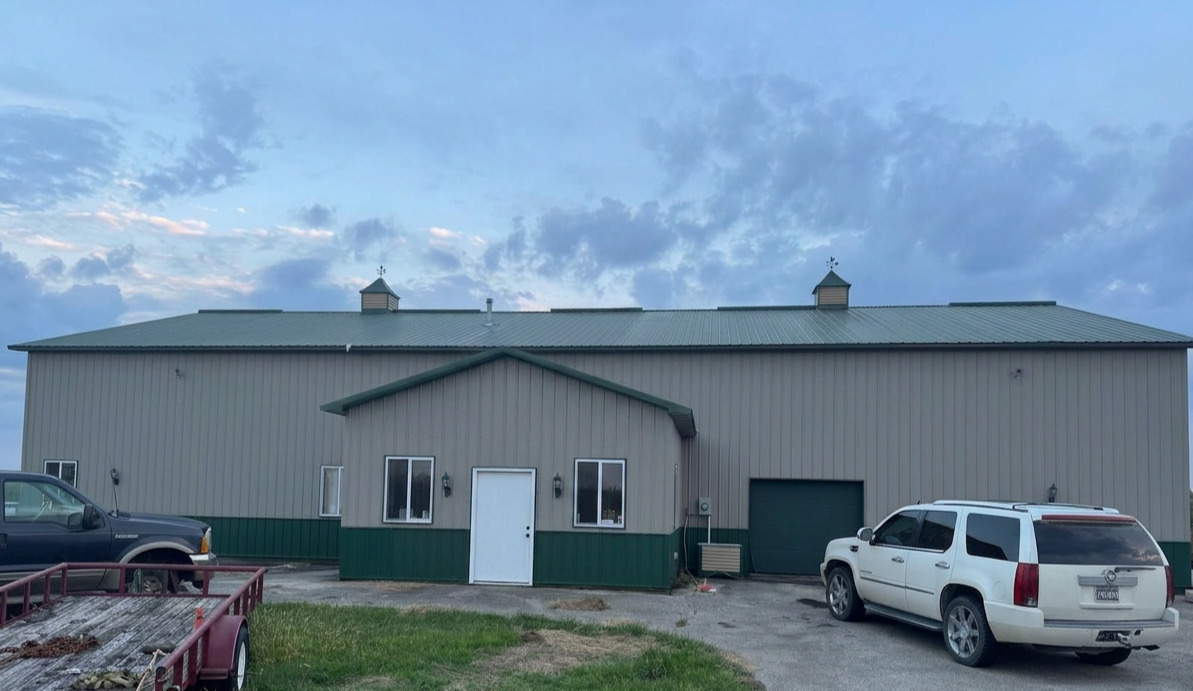
2,000 acres (90M sq ft buildable) in the heart of the Midwest — the only confirmed off-grid AI data center site with 6+ GW of rail-fed power potential. Class I rail spur confirmed, 160 kV and 69 kV power lines accessible, 8M gal/day water, 2 fiber cables on-property plus microwave and 5G backup. No MISO queue. No interconnection wait. Revenue from day one.
Midwest, United States · Location Disclosed to Qualified Buyers
This is a 2,000-acre Ridge AI campus in the heart of the Midwest — with confirmed power, water, rail, and fiber infrastructure already in place or directly accessible. A coal-powered AI data center campus with confirmed off-grid generation capability and a Class I rail spur — this is the only site of its kind available for acquisition in the United States. Erik is a motivated seller willing to accept a significant discount below market value for the right buyer who can move quickly and cleanly. A site valued at $400K/acre is on the table well below that number for a fast close — call to discuss. This is a rare convergence of assets that typically takes years to assemble independently.
Existing building ready for 130 racks — 20 MW modular power plant brings it live from day one. Erik is open to a heavily discounted deal — well below the $400K/acre valuation — for any buyer who can execute in 60–90 days. Contact Erik directly: +359 876 994 282
Site visits don't require a hotel. The property includes a large on-site lodge facility plus the option to deploy 50 heavily discounted container homes — enough to house a full construction and operations workforce from day one.
A large, purpose-built lodge facility already on the property. Accommodates 16 people on-site. For developer site visits, due diligence teams, and engineering surveys, there is no need to commute from a distant hotel. VIP guests land at on-site private airstrip next door, transfer directly to the lodge, and begin work immediately. The facility also serves as an on-site command center during construction.
On-Site — Available NowFifty container homes are available at heavily discounted pricing for the buyer — deployable across the 2,000-acre site to house construction crews, security, operations staff, and engineering teams. Container homes can be installed rapidly with minimal site prep, enabling a self-sufficient workforce village on-site from the earliest phase of construction. No commute, no hotel cost, no staffing logistics headaches.
50 Units AvailableCorporate jets, charter flights, and cargo aircraft land directly next door. Executive teams fly in for site tours, land at on-site private airstrip, and are at the lodge within minutes. Emergency hardware deliveries, engineering consultants, and investor groups all arrive door-to-door. No ground transfer from Midwest region required.
Adjacent — No Ground Transfer16-person lodge on-site now — immediate accommodation for site visit teams, due diligence crews, and VIP investor tours
50 container homes available — workforce village deployable at start of construction; heavily discounted for the buyer
Self-sufficient campus from day one — on-site water, on-site power generation, on-site accommodation; no external dependency during build-out
Reduces construction timeline risk — workforce housed on-site eliminates daily commute delays and labor availability issues common on rural projects
Water availability is an increasing constraint on hyperscale AI expansion. This site sits within pipeline distance of a major freshwater reservoir in the Midwest.
Surface: The Regional Water Authority has confirmed it can deliver 8 million gallons per day via 24-inch pipe to the site. The authority already operates at this scale — supplying counties across the region — so this is not a theoretical figure. Groundwater: The property sits above a groundwater reservoir containing billions of gallons, pumpable on-site independent of any surface pipeline. Combined, these two sources provide substantial water supply capacity across build-out phases.
How long could the regional reservoir support a hyperscale cooling draw from the site's pipeline? Conservative model using normal pool only.
| Daily Draw | Campus Scale | Supply Duration |
|---|---|---|
| 1M gal/day | Mid-scale AI campus | ~198 years |
| 5M gal/day | Large hyperscale campus | ~39 years |
| 10M gal/day | Mega-campus (Microsoft/Google scale) | ~19.8 years |
Note: Practical withdrawal is regulated and shared with downstream users. These figures represent theoretical maximum from stored volume alone — actual permitted draw rates would be negotiated with the state DNR.
Most sites need engineered retention ponds. This site has a natural valley approximately ¾ of a mile wide that can be dammed — creating a private on-site lake with up to 1+ billion gallons of cooling water storage.
A natural valley running approximately ¾ of a mile (3,960 feet) can be dammed on the property, creating a private reservoir. At moderate estimates — 2,000 ft average width, 20 ft average depth — this produces a surface lake of ~182 acres holding over 1.1 billion gallons. That is 148 days of buffer at 8M gal/day without drawing from any external source. The reservoir also provides cooling water directly, enabling closed-loop evaporative cooling at full campus scale.
| Scenario | Surface Area | Volume | Buffer @ 8M gal/day | Buffer @ 20M gal/day |
|---|---|---|---|---|
| Conservative 1,500 ft wide · 15 ft deep · ½ mi long |
~91 acres | 444M gallons | 56 days | 22 days |
| Moderate 2,000 ft wide · 20 ft deep · ¾ mi long |
~182 acres | 1.18 billion gallons | 148 days | 59 days |
| Optimistic 2,500 ft wide · 25 ft deep · 1 mi long |
~303 acres | 2.47 billion gallons | 309 days | 123 days |
Estimates based on valley geometry. Actual volume requires a topographic survey and hydrological study. Dam permitting handled through the state DNR. Local excavation contractors with highway corridor experience are available for earthwork.
This region has a documented layered aquifer system. Regional well records confirm multiple productive zones beneath the site — from shallow glacial gravel to the deep Jordan sandstone. Three working wells already exist on the property at 30 feet depth, providing immediate water access with zero drilling cost.
Three wells drilled to 30 feet depth are already in place on the property, tapping the shallow glacial sand/gravel aquifer. These provide immediate operational water — day one, no waiting, no drilling cost. A buyer inherits proven, working infrastructure. Deeper production wells into the Mississippian or Devonian layers can be added to scale supply as the campus grows.
| Aquifer | Depth | Yield per Well | Regional Record | Notes |
|---|---|---|---|---|
| Shallow glacial sand/gravel | 30–150 ft | 25–150 GPM | 3 wells on-site at 30 ft ✓ | Working now — immediate supply, no drilling required |
| Mississippian limestone | 150–400 ft | 50–250 GPM | ~156 ft (regional public supply well) | Fracture-dependent; industrial quality |
| Devonian/Silurian limestone | 400–800 ft | 100–400 GPM | ~615 ft (regional public supply well) | Good yield; water quality varies |
| Cambrian–Ordovician (Jordan) | 1,800–2,100 ft | 300–800 GPM | ~1,940 ft (regional municipal well) | Highest yield; slow recharge — managed pumping required |
Assuming 250–500 GPM sustained yield per production well (add ~20% standby wells for redundancy):
| Daily Supply Target | GPM Continuous | Wells @ 250 GPM | Wells @ 500 GPM | Role in Campus |
|---|---|---|---|---|
| 1 MGD | 694 GPM | 3–4 wells | 2 wells | Supplemental / backup |
| 5 MGD | 3,472 GPM | 14 wells | 7 wells | Phase 1 secondary supply |
| 10 MGD | 6,944 GPM | 28 wells | 14 wells | Combined with regional water authority primary |
| 20 MGD | 13,889 GPM | 56 wells | 28 wells | Full mega-campus, all sources |
Based on regional hydrogeologic data, groundwater from on-site wells can realistically sustain 1–3 million gallons per day without a full aquifer study. The deep Jordan aquifer can produce more but has slow recharge — sustained heavy pumping requires long-duration pump tests and an aquifer management plan. Groundwater is best positioned as the secondary and emergency supply for the campus, not the primary source.
For full due diligence, the recommended sequence is: desktop hydrogeologic study using regional well records → one 500–800 ft exploratory boring → optional Jordan aquifer test at ~2,000 ft → 72-hour pump test to establish GPM, drawdown, and recovery rate.
Primary: Regional Water Authority — 8M gal/day confirmed via 24" pipe. The authority already has treatment infrastructure; expansion is negotiable for large industrial allocation.
Secondary: On-site groundwater wells — 1–3M gal/day realistic from Mississippian/Devonian layers; Jordan aquifer adds more with proper management.
On-Site Reservoir: A natural ¾-mile valley can be dammed — creating a private lake of 1.1B+ gallons (moderate estimate), providing 148 days of buffer at 8M gal/day with no external supply.
Technology: Closed-loop cooling dramatically reduces daily water consumption vs. once-through evaporative systems.
The site offers the scale, topography, and highway frontage that hyperscale developers require for phased campus development.
2,000 contiguous acres of relatively flat, buildable land — sufficient for phased development from initial build-out through full hyperscale campus at scale. Site can accommodate multiple data center buildings, on-site power generation, coal storage, reservoir, and supporting infrastructure simultaneously.
Direct frontage on a major US highway arterial — providing immediate access for construction equipment, staffing, and logistics.
Midwest location. Low property tax environment, favorable Midwest data center tax incentives, and proximity to regional metro labor pools.
Midwest average temperatures allow for free-air cooling significantly more days per year than Sun Belt sites — directly reducing cooling energy costs and water consumption.
Flat topography — minimal grading required for pad construction, reduces site prep cost
Highway frontage — direct access for oversized equipment delivery
Midwest data center incentives — state tax exemptions on qualifying data center construction and equipment
Private airstrip on the doorstep — corporate aviation direct to site, no ground transfer required; VIP site visits, emergency hardware runs, engineering teams all arrive door-to-door
Low latency to Chicago — within driving distance / excellent fiber path to the nation's largest interconnection hub
Water supply distance — 18–22 miles to the regional reservoir is within proven pipeline economics for hyperscale projects
Most greenfield data center sites generate zero revenue during a multi-year construction period. This site is different — an existing on-site building is ready to house 130 racks immediately, powered by a modular coal conversion plant. A coal-powered data center operational before a single shovel breaks ground on the wider campus.
At an AI-optimised rack density of approximately 150 kW per rack, 130 racks draws ~20 MW — a load that a modular coal power conversion plant can supply on-site, independently of the grid, before any utility interconnection work begins. This means a buyer can generate revenue from colocation or AI compute leasing from the first day of ownership while the larger 6+ GW campus is being permitted and constructed.
An existing on-site structure is ready to be fitted out as a live data center. No construction lead time for the Phase 0 facility — fit-out, cooling, and rack deployment can begin immediately after purchase. At AI workload densities, 130 racks represents a meaningful revenue-generating operation from the outset.
Existing Structure — No Build WaitA modular coal-to-power conversion plant sized at 20 MW can be deployed on-site to power the Phase 0 facility entirely off-grid. Modular coal plants are factory-built, containerised, and deployable in weeks rather than years. With on-site coal reserves and Class I railroad rail supply confirmed, fuel cost and availability are not a constraint.
Off-Grid — No Interconnection QueuePhase 0 provides immediate cashflow while the full 6+ GW campus is developed in parallel. The modular power plant scales — additional modules can be added as more racks are deployed. By the time grid interconnection is complete, the campus already has a live operational track record, a customer base, and proven infrastructure.
Staged Growth — Revenue From Day OneNo revenue gap — existing building eliminates the typical 2–4 year construction period before first dollar of revenue
MISO queue bypass from day one — modular coal plant provides 20 MW entirely off-grid, independent of the Midcontinent Independent System Operator interconnection queue. No 5–10 year wait.
AI rack density ready — 130 racks at ~150 kW/rack covers GPU cluster, inference, and training workloads at commercial scale
Fuel secured — on-site coal reserves plus Class I railroad rail supply means modular plant fuel is available at lowest cost, no grid dependency
Scales in modules — add power modules as rack count grows; no single large capital commitment required upfront
The figures below are indicative estimates based on current market rates for GPU compute and AI colocation. They are scoped to the existing on-site building (130 racks, ~20 MW) only — they do not reflect the broader campus potential. Actual results will vary with utilisation, contract pricing, and equipment financing terms.
Owner purchases GPU servers, rents compute time to AI companies and cloud consumers.
| GPU fleet | ~15,600 H100s |
| Gross revenue (est.) | ~$250–270M / yr |
| Power + ops (est.) | −$17M / yr |
| Equipment financing (est.) | −$148M / yr |
| Est. net cash / yr | ~$90–110M |
Based on $2.50/GPU/hr, 80% utilisation, ~$608M equipment financed at 8% over 5 yrs. High return, high capital requirement.
Owner provides power, space, and cooling. Tenants bring and own their own GPU hardware.
| Sellable capacity | 20,000 kW |
| Gross revenue (est.) | ~$43M / yr |
| Power + ops (est.) | −$12M / yr |
| Fit-out financing (est.) | −$9M / yr |
| Est. net cash / yr | ~$22M |
Based on $180/kW/month, ~$50M fit-out financed at 8% over 7 yrs. Lower capital, lower risk — tenant brings the GPU capex.
Power cost advantage: Coal-sourced on-site power at an estimated $0.03–0.05/kWh vs. grid rates of $0.07–0.12/kWh saves $3–5M/year versus a grid-dependent competitor operating at the same scale — a structural margin advantage on either model.
Every major hyperscale AI developer evaluates sites against the same checklist. This hyperscale AI campus land checks every box — including off-grid coal power and fiber connectivity that most rural sites never can match.
The railroad has confirmed a rail spur can be built to offload a complete unit coal train. Active engagement with the railroad's coal sales team. Rail also enables construction logistics at scale.
Spur Confirmed by Class I RailroadTwo named fiber carriers confirmed on the property: carrier-owned dark fiber (highway corridor, direct controller access) and a national carrier long-haul route. Both cables run to Chicago — the nation's largest interconnection hub. Independent microwave and T-Mobile 5G add further redundancy. Most competing sites negotiate for one fiber route — this site has two named providers plus two independent backup channels.
4 Data Paths + 1 Probable Fiber160 kV transmission line accessible, with 69 kV sub-transmission also available. A regional transmission owner manages this corridor. The regional utility is the designated retail supplier — direct contact is established.
Utility Contact EstablishedClass I rail spur enables dedicated on-site coal generation — 1,078 MW continuous from one train per day, scaling to 2+ GW at two trains/day. Eliminates grid interconnection queue entirely.
1 GW+ PotentialRegional water authority confirmed 8M gal/day via 24" pipe. Four aquifer layers beneath the property provide 1–3M gal/day additional. 2,000 acres supports on-site reservoir and dedicated coal storage. Total potential exceeds any realistic campus demand.
8M Gal/Day Confirmedon-site private airstrip sits immediately adjacent to the property boundary. Corporate jets land direct — no ground transfer required. Executive site visits, engineering teams, and emergency hardware deliveries all arrive door-to-door. A private airstrip this close to a hyperscale campus is a premium feature most sites cannot offer.
Immediately AdjacentDirect highway frontage on a major US arterial. The Midwest is established data center country — Google, Microsoft, Meta, and Apple all operate Midwest campuses. Proven state regulatory environment and utility relationships.
Proven MarketFiber access is one of the most expensive and time-consuming problems in data center site selection. Here, it isn't a problem — two confirmed fiber cables are on the property, both routing to Chicago, plus independent microwave and 5G backup channels.
A regional fiber carrier provides dark fiber via a cable running directly under the property driveway — physically on-site, immediately accessible, zero trench cost to connect. Dark fiber means the campus operator leases the raw strand with no shared bandwidth, no carrier throttling, and unlimited capacity. Dark fiber access is available directly — contact details provided to qualified buyers. Backbone routing direct to Chicago — the nation's largest internet exchange hub — and onward to all major US markets.
A national fiber carrier runs a carrier-grade long-haul route directly along the highway on the property, connecting through to Chicago. Two fiber providers on the same physical corridor gives the campus redundant paths from separate carriers — a core requirement for Tier III and Tier IV certification.
A licensed microwave operator provides a confirmed microwave data connection serving the site — a third independent data channel that is entirely separate from both fiber cables. Microwave links are immune to cable cuts and provide genuine physical-path diversity. Combined with T-Mobile 5G, the site has four named independent data paths: carrier dark fiber, national carrier fiber, licensed microwave, and T-Mobile 5G.
Hyperscale AI campuses require massive and redundant bandwidth for: model training data transfer between sites, inference serving to end users globally, inter-campus replication and failover, and cloud provider backbone connectivity. The industry standard for mission-critical facilities is diverse entry points from at least two physically separate carriers. Having two fiber cables (carrier dark fiber + national carrier long-haul), both routing to Chicago, plus a microwave link and 5G on a single rural site means a developer can meet Tier III redundancy requirements on day one without any off-site fiber construction. This alone eliminates a 12–24 month infrastructure lead time that competing greenfield sites face.
Dark fiber — direct controller access — the fiber carrier contact controls the cable; deal can be done without any carrier intermediary. Unlimited capacity on leased strand, lowest possible latency.
National carrier fiber route — carrier-grade long-haul on the highway corridor, contact available to qualified buyers
Both fiber routes terminate in Chicago — direct path to the nation's largest internet exchange, with onward connectivity to all US and transatlantic markets
Path diversity — two physically separate fiber carriers on the same highway corridor, no shared conduit risk, qualifies for Tier III/IV dual-carrier redundancy from day one
No fiber construction required — cables already present; campus can connect immediately rather than waiting years for a fiber build
The railroad has confirmed a rail spur can be built to serve this site. Each unit coal train delivers 100–300 MW of sustained power capacity — making this the most credible coal-powered AI data center opportunity in North America. Class I main lines support multiple deliveries per day. Total power scales to 6+ GW with zero MISO queue dependency.
A standard unit coal train carries 120 cars × 110 tons = 13,200 short tons of high-BTU coal (17.6M BTU/ton) — delivering 100–300 MW of sustained power capacity per train. Class I main line coal corridors routinely run 20+ trains per day. With a dedicated rail spur and on-site storage, the site can receive multiple deliveries daily. At 20 trains per day, that is up to 6 GW of coal-fed generation capacity — more than enough to power the largest AI hyperscale campus ever proposed.
| Trains / Day | MW per Train | Total Power Capacity | Campus Scale |
|---|---|---|---|
| 1 train / day | 100–300 MW | 100–300 MW | Phase 1 build-out |
| 3 trains / day | 100–300 MW | 300 MW – 900 MW | Large AI campus |
| 5 trains / day | 100–300 MW | 500 MW – 1.5 GW | Full hyperscale campus |
| 10 trains / day | 100–300 MW | 1 GW – 3 GW | Multi-tenant mega-campus |
| 20 trains / day | 100–300 MW | 2 GW – 6 GW | Largest AI campus ever proposed |
The Class I railroad has confirmed a spur can be built at the property to offload a complete unit coal train. The railroad's coal sales team is actively engaged on this project — contact available to qualified buyers.
2,000 acres (90M sq ft) supports a dedicated on-site generating station, coal storage yards, and the full data center campus — with room to spare. On-site generation eliminates grid interconnection queues entirely — no waiting in the MISO queue. Power is available when you need it.
A 10-acre coal storage pad (8 ft deep) holds approximately 87,000 tons — 6.6 unit train loads — providing 7+ days of buffer at 1,000 MW draw. And that's before counting what's under the ground.
An abandoned coal mine runs beneath the property — part of a historic Midwest coalfield that operated extensively from the 1800s through the mid-1900s. The mine was not exhausted. It was idled when rail-delivered high-BTU coal from Wyoming became cost-competitive. Here's the important distinction: local Midwest bituminous coal is actually 31% higher BTU per ton than Wyoming PRB coal (23M BTU/ton vs 17.6M BTU/ton). The economics changed, not the quality.
| Coal Type | BTU / Pound | BTU / Ton | MWh / Ton (38% eff) | Status |
|---|---|---|---|---|
| Midwest Bituminous (on-site) | ~11,500 BTU/lb | 23.0M BTU/ton | 2.56 MWh/ton | Under Property |
| PRB Coal (rail-delivered) | ~8,800 BTU/lb | 17.6M BTU/ton | 1.96 MWh/ton | Via Rail Spur |
| Estimated On-Site Reserve (Conservative) | |
|---|---|
| Area over mine workings | 2,000 acres (est.) |
| Avg seam thickness | ~3.5 ft |
| Estimated coal remaining | ~6.4M short tons |
| Equivalent unit trains | ~485 trains |
| Total energy (38% eff) | ~16.4M MWh |
| Continuous Power Duration from Reserve | |
|---|---|
| 100 MW campus | 18.7 years |
| 300 MW campus | 6.2 years |
| 500 MW campus | 3.7 years |
| 1,000 MW campus | 1.9 years continuous |
| Blending (30% Midwest / 70% PRB) | +9.2% effective BTU |
Higher BTU than rail-delivered PRB coal — Midwest bituminous at 11,500 BTU/lb vs PRB at 8,800 BTU/lb. More energy per ton burned.
Zero freight cost — PRB coal costs $15–25/ton in rail freight to reach the Midwest. On-site coal has no delivery cost. With rail spur already on the property, the freight saving per ton of on-site coal used directly offsets Class I railroad shipping. At 6.4M tons across the 2,000-acre property, that's potentially $96–160M in avoided freight over the life of the reserve.
Blending opportunity — mix 30% on-site Midwest coal with 70% rail-delivered PRB coal to increase effective BTU by ~9% and reduce rail freight dependency.
~6.4M tons estimated remaining — conservative estimate based on 2,000 acres over workings, 3.5 ft seam, 50% in-place. Equivalent to ~485 full unit trains. Actual reserve volume requires a mine survey and core sampling to confirm.
Backup fuel independence — on-site reserves provide months of emergency fuel supply independent of rail delivery schedules.
Geotechnical survey required — abandoned mine workings create subsidence risk. A mine map study and geotechnical investigation must be completed before siting building foundations. Standard practice for former coal mining areas.
Flooded mine water — abandoned mine workings typically fill with groundwater over time. This additional water resource may be pumpable for supplemental cooling supply after treatment.
The site operates inside the MISO (Midcontinent Independent System Operator) wholesale electricity market. Multiple generators — wind, coal, gas, nuclear — compete and sell power into MISO. That power is physically transmitted over the regional transmission owner infrastructure (the wires). At the retail level, the regional retail utility is the designated electric provider for this area. Direct utility contact is already established. For on-site coal generation fed by Class I railroad rail, the campus bypasses the retail grid entirely for that portion of its load.
160 kV regional transmission line accessible — supports meaningful grid interconnection capacity for data center load. The regional transmission owner owns and operates this infrastructure.
Accessible69 kV sub-transmission also available — useful for phased build-out, temporary construction power, or supplemental load during early campus development before on-site generation is fully operational.
AvailableAll grid power purchased through the regional utility. Direct utility engagement already established. Midwest industrial power rates are among the lowest in the U.S.
Contact EstablishedSite positioned for evaluation by leading hyperscale AI developers
Proximity to transmission is one of the hardest boxes to check in site selection. Two voltage tiers — 160 kV and 69 kV — are accessible, providing both primary interconnection capacity and a redundant sub-transmission feed.
A regional transmission owner manages the transmission corridor. The three numbers that matter to any hyperscale developer: (1) line voltage of that corridor, (2) available substation capacity at the nearest interconnection point, and (3) interconnection queue timeline for a new load of 100 MW / 300 MW / 500 MW. Both 160 kV and 69 kV lines are accessible, providing redundant grid feed options. Regional utility contact is established and can provide answers from the distribution/load side.
4-mile distance is well within the range developers routinely fund. 10–15 miles is typical; 4 miles is short.
On-site generation as backup/supplement reduces grid dependency while substation upgrades are built.
Regional utility contact established — utility engagement at this stage is ahead of most competing sites.
160 kV & 69 kV accessible — Two voltage tiers available. Verification with the transmission owner or retail utility will confirm substation capacity and interconnection queue timeline.
The valuation is $400K/acre and every number in this prospectus backs that up. But Erik is not looking to hold this asset — he is looking to transact. A buyer who can move in 60–90 days will get a price that is substantially below market value. No drawn-out negotiation, no gazumping, no agent chain. Call Erik directly, make an offer, and get a straight answer.
Contact Erik — Discuss Terms